
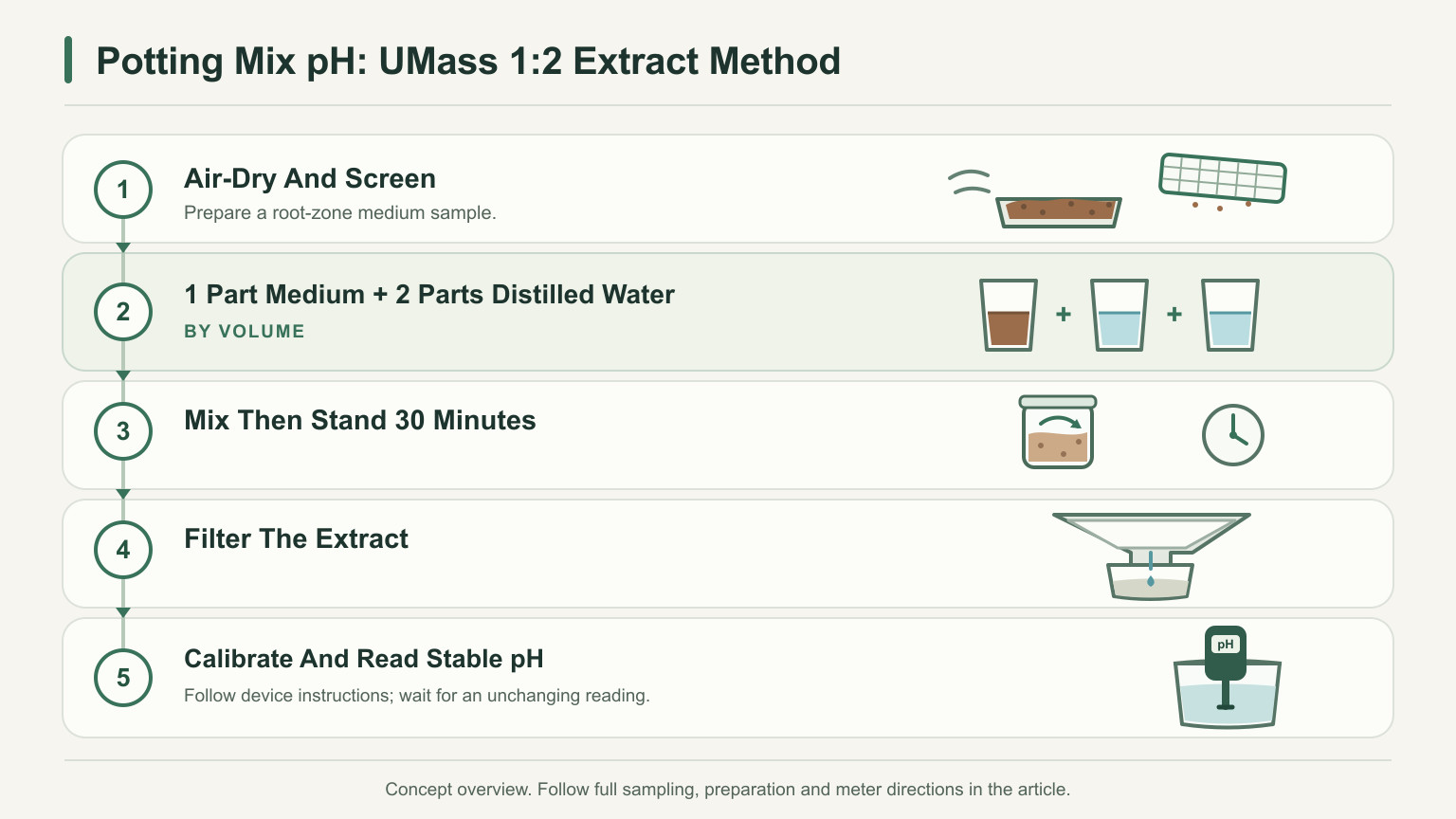

If you want to check the acidity or alkalinity of your container’s mix, the pH pen is only one part of the check. How you collect and prepare the sample matters to what its number can tell you.
The steps below follow UMass Extension’s 1:2 growing-media method, using a prepared sample and a calibrated pen. The result describes that sampled medium under that procedure. It is separate from a water test or a reading taken from liquid that has drained out of a pot.
Identify The Container Medium
Record whether the mix is soilless or contains field soil, along with the crop and growth stage. A result describes the sampled pot or comparable group, not every container nearby. Garden-bed soil, irrigation water, and liquid drained from a pot are different samples or tests.
If you’re still choosing a medium, see Potting Mix And Drainage For Container Vegetables. For a home-blended mix, note its ingredients and proportions; How To Measure And Batch A Sourced DIY Potting Mix explains how to batch a sourced formula.
pH describes acidity or alkalinity. Electrical conductivity (EC) reflects dissolved salts, and individual nutrient amounts require additional analysis (pH and EC in soilless substrates).
Take A Representative Sample
Choose the pot or comparable crop-and-medium group you want to check. Sampling removes medium and can disturb roots. If you cannot reasonably collect a representative sample, ask a growing-media laboratory or Extension adviser about an appropriate method before proceeding.
Take several small portions from the root zone. If you combine material from multiple containers, use pots with the same crop and medium, mix the portions in a clean container, and record which pots contributed. Keep different crops or mixes separate. For a problem-plant check, keep normal and problem plants in separate samples. The container-media sampling details explain these grouping and root-zone points. A pinch from the surface does not represent the root zone.
Use clean collection and preparation containers. Remove large roots and debris. If controlled-release fertilizer pellets are visible, pick them out carefully without crushing them; broken pellets can add fertilizer to the sample. Record recent watering and fertilizer use. If recent treatment could affect how well the sample represents the medium, ask a growing-media lab or Extension office for timing guidance.
Spread the sample in a clean shallow pan and let it air-dry at room temperature. Don’t use an oven or other forced heat. Screen the dry material with a colander or similar sieve. A wet sample may need more than a day to dry, so don’t treat 24 hours as a deadline.
Prepare And Calibrate The pH Pen
Gather a pH pen suited to liquid samples and its compatible calibration buffers, distilled water, a measuring cup, two roomy clean jars, a funnel and coffee filter, a shallow pan, a sieve or colander, and a separate clean test cup.
Check the pen’s manual for calibration buffers and controls, temperature conditions, sensor immersion, cleaning, and storage. Follow its procedure; a buffer pair or button sequence from another pen may not apply. If you cannot establish the correct calibration requirements, resolve that before testing.
When establishing a routine, calibrate at the start of each testing session; follow stricter manufacturer instructions if they call for more frequent calibration. Use a clean portion of buffer, let the reading stabilize, and adjust the instrument as directed. Discard the used buffer and rinse it from the sensor before measuring the extract. If the pen will not calibrate or produce a stable reading, stop; the display alone is not a usable result.
Make And Read The Extract
Use the same cup or marked vessel for both materials. Measure one volume of prepared, air-dried, screened medium and two equal volumes of distilled water. For example, fill one cup with medium, then use that same cup twice for the distilled water. The 1:2 ratio is medium to water by volume, not two total parts or a weight ratio.
- Add the measured medium and distilled water to a roomy clean jar.
- Swirl thoroughly, then let the mixture stand for 30 minutes.
- Pour it through a coffee filter supported in a funnel. Collect the liquid in a second clean jar and discard the solids.
- Pour enough filtered extract into a clean test cup to immerse the sensor as its manual requires. Don’t add water to the finished extract to make it deeper. If there is too little liquid, repeat the preparation with a larger representative portion of medium and the same 1:2 ratio.
- Confirm the pen is calibrated. Immerse the sensor as directed, swirl it gently to dislodge bubbles, and hold it still until the reading stabilizes. Record the pH shown. No fixed wait time guarantees a stable reading. Rinse and care for the pen afterward as its manual directs.
The measured cups define the extraction ratio, not the amount of filtered liquid you will collect. Record only the result you actually read.
Record The Reading
Keep a short record with the pH value:
- Sample: date and time; pot or group ID; contributing pots; crop and stage; soilless or soil-containing medium; recent watering and fertilizer context.
- Preparation: root-zone sampling; air-drying and screening; one volume of medium plus two equal volumes of distilled water; 30-minute stand; filtration.
- Instrument: pen model; calibration buffers and date; temperature or immersion requirements from its manual.
- Result: the actual stable pH shown, the method used, and any follow-up information.
Interpret The Result And Follow Up
Use interpretation guidance appropriate to the recorded method and relevant crop and medium. Do not assume results from different extraction methods are directly comparable. A pH reading alone neither diagnoses a nutrient deficiency nor tells you what amendment to add. There is no single pH target for every edible crop.
If a result surprises you, check the sample identity, recent treatment notes, drying and screening, measured volumes, distilled water, stand time, filtration, and pen calibration. When another result would help, repeat with a fresh representative sample using the same method. Keep readings from unlike samples or different methods separate in your record.
For a reading that remains suspect or an uncertain crop-specific interpretation, contact a growing-media laboratory or Extension adviser. If sending material to a lab, follow that lab’s current collection and shipping directions. The air-drying procedure here belongs to the on-site pen test; laboratory submissions may require different handling.