
A fertilizer bag gives you several kinds of information, and the large numbers on the front are only part of the story. Reading the rest can help you work out whether that exact product has directions for your crop and container.
Start with the product identity and intended use, then separate the guaranteed analysis from the application instructions. The N-P-K grade describes nutrient percentages by product weight; the directions explain the rate and method. The examples below show how to keep those roles distinct.
Start With The Label You Actually Have
Read the package in your hand, not a similar product’s label. Note the exact product name, manufacturer, formulation or grade, and intended use. Then find the main parts of the label:
| Label area | What to record |
|---|---|
| Product identity | Exact name, formulation or grade, manufacturer, and intended crop or use. |
| Guaranteed analysis | Nutrient guarantees, units and reporting bases, indented rows, and footnotes. |
| Derived-from list | Materials named as sources of the guaranteed nutrients. |
| Directions | Crop and container branch, product amount and rate basis, and other use conditions. |
A manufacturer’s online sheet is useful only when it matches the product and formulation on the actual bag. Do not calculate from a sheet when a needed panel is missing, unreadable, or mismatched; get complete current manufacturer directions for that product and use first. A similar product’s instructions and the grade on the front cannot fill in for missing directions.
Read The Guaranteed Analysis
On U.S. fertilizer labels, the N-P-K grade gives guaranteed percentages by product weight. A 3-4-4 label lists 3% total nitrogen (N), 4% available phosphate as P₂O₅, and 4% soluble potash as K₂O. P₂O₅ and K₂O are reporting bases, not elemental phosphorus and potassium percentages. The grade describes composition; it is not an application amount.
For a plain-language explanation, see what fertilizer nutrient percentages mean.
Read the other lines in the guaranteed analysis too. Indented rows can break a nutrient into forms, and footnotes may describe only one row. Do not add a subrow to its total a second time. The derived-from list names nutrient materials; it does not show that a container needs another nutrient.
Grade and proportion are related but different. Products labeled 5-5-5 and 20-20-20 have the same 1:1:1 proportion on their stated bases. At equal product weight, each 20% guarantee is four times the corresponding 5% guarantee. That comparison does not make the products interchangeable or tell you to change an application rate.
Match The Directions To Your Container
Find the directions for the exact crop, container, and growth stage before using an amount. One label may give separate directions for established pots, new plants, herbs, beds, or rows. Do not transfer a rate from one branch to another.
Copy the product amount and its basis together. A rate may be per pot diameter, volume of growing mix, or volume of water. Those measures are not interchangeable: teaspoons of dry product are not grams of nutrient, and pot diameter is not container volume.
For a soluble fertilizer, find both parts of the direction: how much product to mix into water and how much prepared solution to apply. A product-to-water concentration alone does not say how much solution goes into one pot. Get the missing application direction before calculating or using it.
Read Method, Repeat, And Precautions
After choosing a use branch, read how to apply the product, where to place it, whether to water afterward, and what timing or repeat conditions apply.
Keep physical form separate from nutrient release. “Granular” describes the product’s form; it does not show how quickly nutrients become available or how long they last. A slow-release note can describe one nutrient without setting a release period for the whole product.
A matching safety data sheet can add handling and storage information. Use the product directions for application amounts and methods.
A Worked Label Reading And What To Do Next
This example uses the current manufacturer-linked direction sheet for Garden-tone 3-4-4. It is a label-reading demonstration, not a product recommendation or a plant trial. The actual bag and formulation must match before using its directions.
| Label detail | What the example shows |
|---|---|
| Guaranteed analysis | 3-4-4 means 3.0% N, 4.0% available phosphate as P₂O₅, and 4.0% soluble potash as K₂O, by product weight. |
| 100 g teaching calculation | For an arbitrary 100 g of product: 100 g × 3 ÷ 100 = 3 g N; 100 g × 4 ÷ 100 = 4 g on the P₂O₅ basis; and 100 g × 4 ÷ 100 = 4 g on the K₂O basis. This explains the label’s mass basis. It is not a dose, actual sample, or measurement of plant uptake. |
| Indented rows and other guarantees | The nitrogen subrows are 0.2% ammoniacal N, 0.6% other water-soluble N, and 2.2% water-insoluble N: 0.2% + 0.6% + 2.2% = 3.0% total N, by product weight. The label also lists calcium 5%, magnesium 1% (including 0.7% water-soluble magnesium), and sulfur 2%. Each subrow is part of its nutrient total, not an extra amount. |
| Established-plant branch | Potted Plants → Established Plants: 1.5 teaspoons of product per 4 inches of pot diameter. This rate is separate from the 100 g composition calculation; no pot dose is calculated from it here. |
| Method and repeat timing | Apply along the soil’s outer edge, keep the product 3 inches from the stem and off stems and foliage, then water thoroughly. The established-plant direction is monthly during the growing season, usually May through August. That timing applies to this product; it does not show that every nutrient lasts a month. |
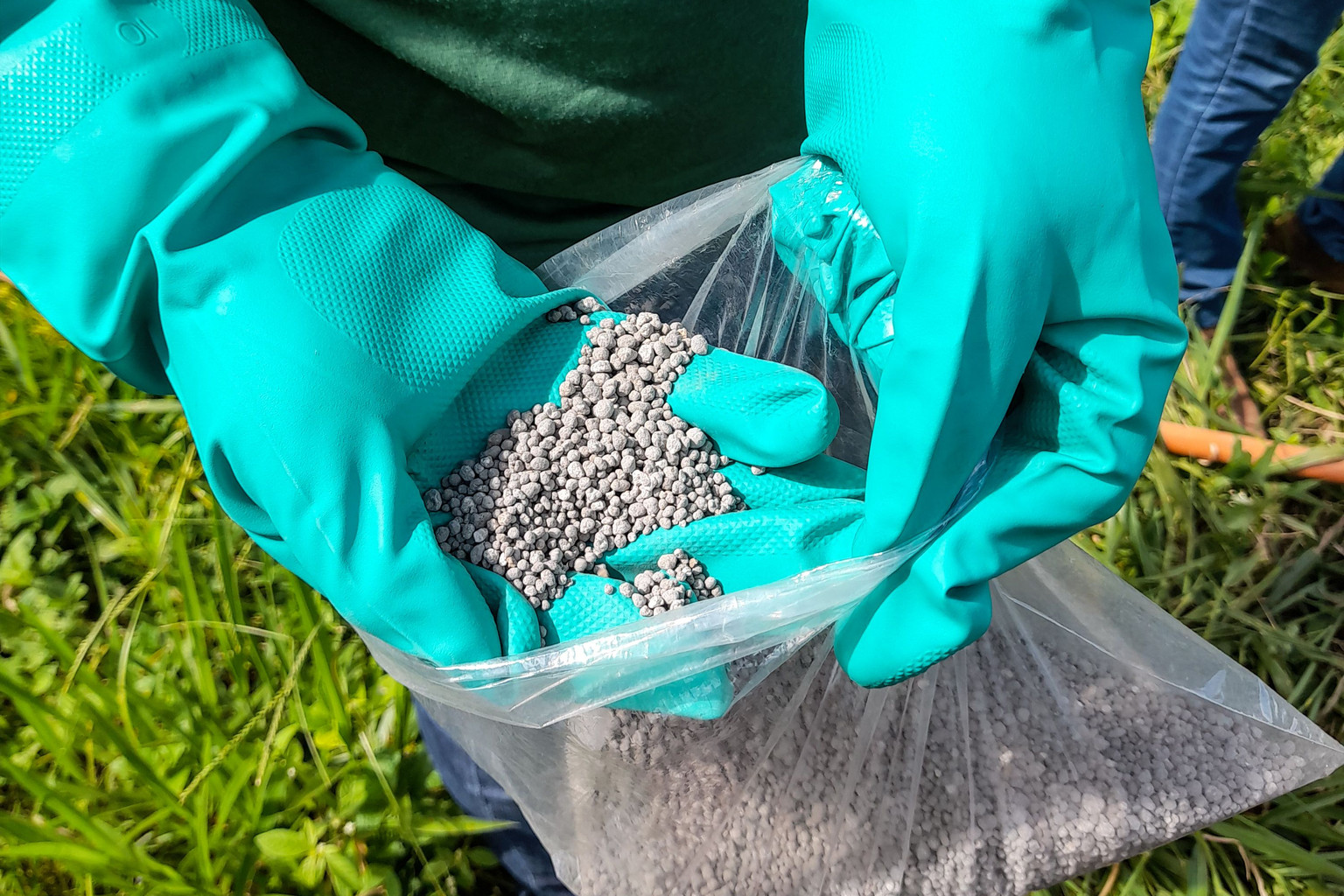
| Handling and storage | Wear gloves, wash hands, and store in a cool, dry place out of children’s and pets’ reach, following the current product directions. |
The manufacturer’s new-mix directions conflict on volume, and its transplant-start timing differs between the product page and direction sheet. Those branches are excluded here. Get manufacturer clarification before using either; do not average or choose between the conflicting directions.
Before applying, check three things:
- The actual label matches the product and intended use.
- The crop, container, and stage fit the selected branch, and its rate, method, timing, and precautions are complete.
- The growing mix, included fertilizer, and previous feedings are known.
When a check fails or directions conflict, hold off on measuring or applying. Get matching manufacturer directions or clarification and recover any missing information about the mix or previous feeding. Reading a label describes the product; it does not show that a container needs feeding.
For the broader feeding plan, see build a fertilizing plan from your label and existing inputs.