
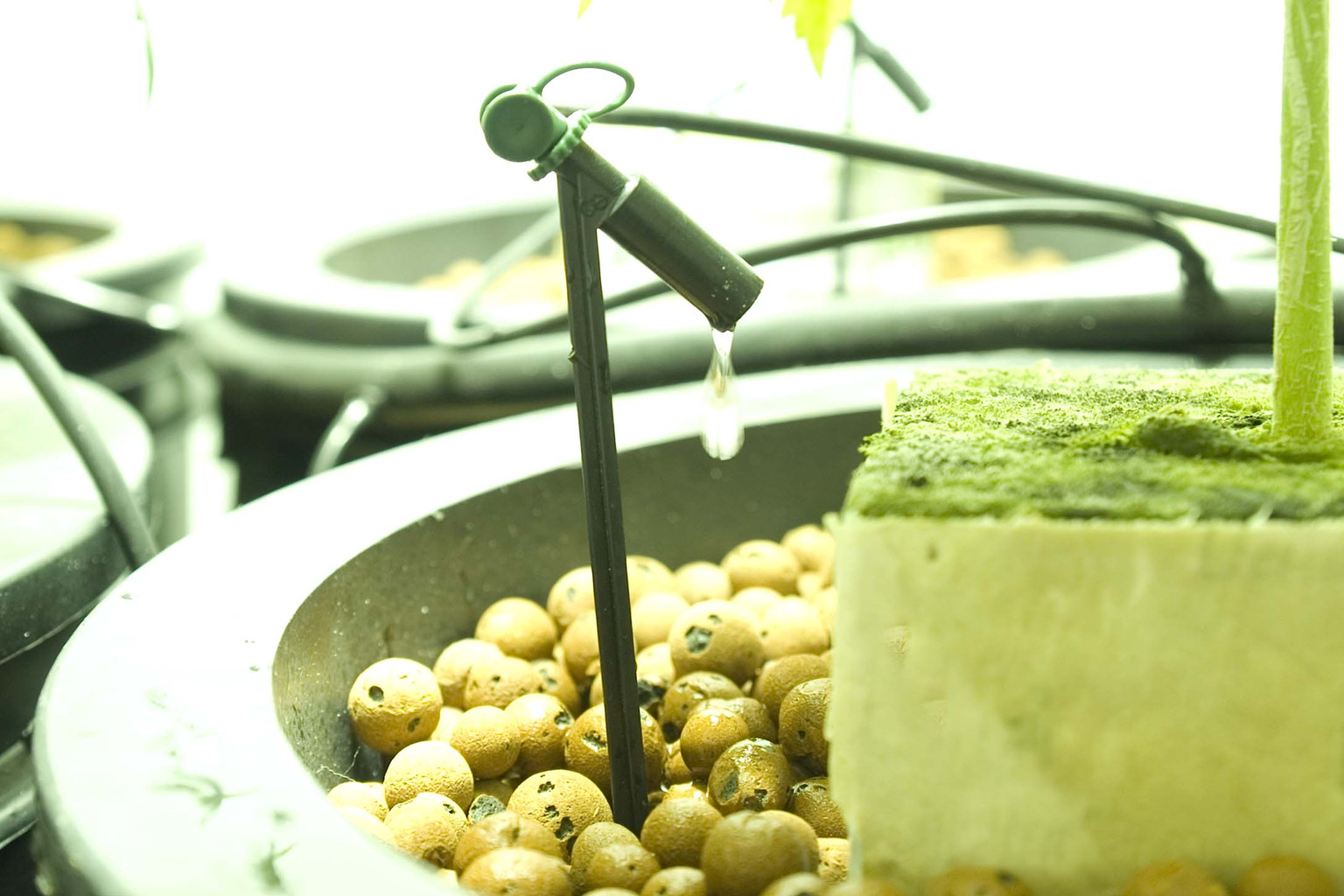

If you already water vegetable pots through drip lines, you may be considering whether fertilizer could travel through the same system. That decision involves the plants’ needs, the product directions, and the actual equipment and water supply.
Before mixing anything, confirm compatibility, suitable backflow protection, and what each pot would receive. Having an injector does not establish that the plants need feeding or that a setup is suitable. Hold fertilizer while any essential detail remains unresolved.
Start With The Plant, Product, And Existing Inputs
Record the crop and growth stage, the exact growing mix, any fertilizer or amendments already in it, and previous feedings. Then check the fertilizer label for that crop, container, and method of use. Having an injector does not mean the plants need another feed.
When the mix, precharge, or feeding history is unknown, get that information before calculating or preparing more fertilizer. Use the product directions that match the package in hand. You can also check the container’s existing fertilizer and feeding plan.
Check The Exact Equipment And Water Supply
Match The Injector To The Actual System
Write down the injector’s exact make and model. Check its current manual for operating pressure and flow, whether it can stay under pressure between watering cycles, any required pressure difference across the injector, and the permitted filter, timer, regulator, and emitter arrangement. Check the actual irrigation zone, not just the hardware’s advertised or estimated flow. Confirm that the setup lets you stop fertilizer while water continues to flow.
The EZ2005-HB is one model-specific example. Its 2024 installation and operating guide describes a low-pressure hose and drip feeder. It prohibits constant-pressure installation and pressure above 50 PSI at the feeder. When incoming water pressure is over 50 PSI or unknown, the guide calls for a regulator set to 40 PSI. It also says the hose-bib adapter should be the last component when possible, with no timer, filter, or regulator after it. These limits and layout instructions apply to that model, not every drip system.
That adapter layout differs from a field fertigation setup that injects before filtration. These instructions cover different systems. Get a compatible layout confirmed by the injector and irrigation-component manufacturers or a qualified irrigation installer before injecting.
Confirm Protection For The Water Supply
Protection against fertilizer water flowing back into the supply must fit the water source, fertilizer, and plumbing arrangement. Confirm the required protection and any inspection or testing with the water supplier, local authority, or a qualified backflow professional. A hose attachment or injector accessory is not proof that the setup meets the requirements for that supply. Keep the hose used to fill the fertilizer tank out of the fertilizer solution. Do not inject until the supply protection is confirmed.
Check The Fertilizer And Mixing Directions
Use a fertilizer whose label permits the crop, container, and application method, and whose mixing directions match the injector. “Liquid,” “granular,” “water-soluble,” and “organic” do not by themselves establish compatibility. The EZ2005-HB guide limits that model to nonhazardous products and excludes dry broadcast fertilizers; any soluble product still has to fit its label and the injector’s instructions.
Follow the exact label and manual for stock preparation, water, and any required predilution. Do not make a slurry or copy a mix from another system. Fertilizers that work separately can form solids when concentrated together. For example, some concentrated calcium products can precipitate with sulfate- or phosphate-containing products. That is one compatibility concern, not a complete mixing chart. Stop before mixing when directions conflict or compatibility is unknown, and contact the product and equipment manufacturers for instructions that fit the actual combination.
Follow the fertilizer’s handling and storage directions, and keep mixing and storage away from a wellhead.
For more on the package directions, read the fertilizer label and its application directions.
Understand What The Injector Delivers
Keep three things separate: the fertilizer mixture in the tank (stock solution), the injector’s setting or ratio under its operating conditions, and the prepared solution each container receives. A dial or ratio alone does not give the final nutrient concentration, amount per pot, or feeding frequency. Use the exact model’s definition; do not borrow a ratio convention from another injector. Solution color can show that material is present, but it does not measure concentration.
Check the product’s application directions and how much solution reaches the actual containers. An emitter’s rated flow or a timer setting is not a measurement of the amount delivered to each pot. If you know only the tank concentration or dial setting, do not calculate or apply fertilizer until you have the missing stock, injector, delivery, and crop-use instructions. For more detail, check what a fertilizer injector actually delivers.
Make The Go Or Hold Decision
Before feeding, check that each item is covered by the actual product and equipment instructions:
| Check | Ready to proceed when | Hold when |
|---|---|---|
| Plant and existing inputs | Crop, stage, mix, precharge, amendments, and prior feeds are known; feeding is appropriate. | The mix, label, or feeding history is missing. |
| Injector and layout | Exact model, pressure, flow, pressure conditions, component order, and stop method fit the whole system. | Ratings, layout, or a compatible shutoff method are unknown or conflict. |
| Water supply | Suitable backflow protection for the source and arrangement has been confirmed. | Protection has not been confirmed. |
| Fertilizer and stock | The label permits the crop and method; mixing and compatibility instructions are complete. | Use, stock preparation, or compatibility is unclear. |
| Delivery and finish | A supported water-only check works, actual delivery is understood, and the required post-feed flush is known. | There are leaks, failed injection, uneven flow, missing application directions, or no flush plan. |
In this hypothetical example, the gardener has a matching EZ2005-HB guide, but actual operating conditions and supply protection are unverified. A proposed filter-after-adapter layout comes from another system, the fertilizer directions do not establish the injector stock or amount per container, and the water-only check and finish plan are missing. The decision is HOLD. Confirm a compatible layout and supply protection, get complete product and injector directions, then perform the required checks. No dose can be calculated from the information available.
Before the first feed, use plain water to check pressure, leaks, and emitter delivery in the intended zone. Confirm how fertilizer can be stopped while water keeps flowing. A successful water-only run does not prove chemical compatibility, backflow protection, or nutrient concentration.
After feeding, follow the product and equipment directions for fresh water or flushing. The EZ2005-HB guide calls for fresh water through the garden hose after each use; it does not set a universal flush time or volume for every setup. Do not overwater containers just to empty a tank.
Cloudiness or solids, repeated clogs, failed injection, or uneven delivery are reasons to stop adding fertilizer. Shut off pressure before opening or disconnecting the EZ2005-HB; its guide warns that residual fluid may escape and says to direct the fitting away from your face and body. For persistent problems, follow the exact troubleshooting instructions and contact the product or equipment manufacturer, supplier, or a qualified irrigation professional with the product, water, and system details. Do not increase fertilizer or assume every pot received a missed dose.