
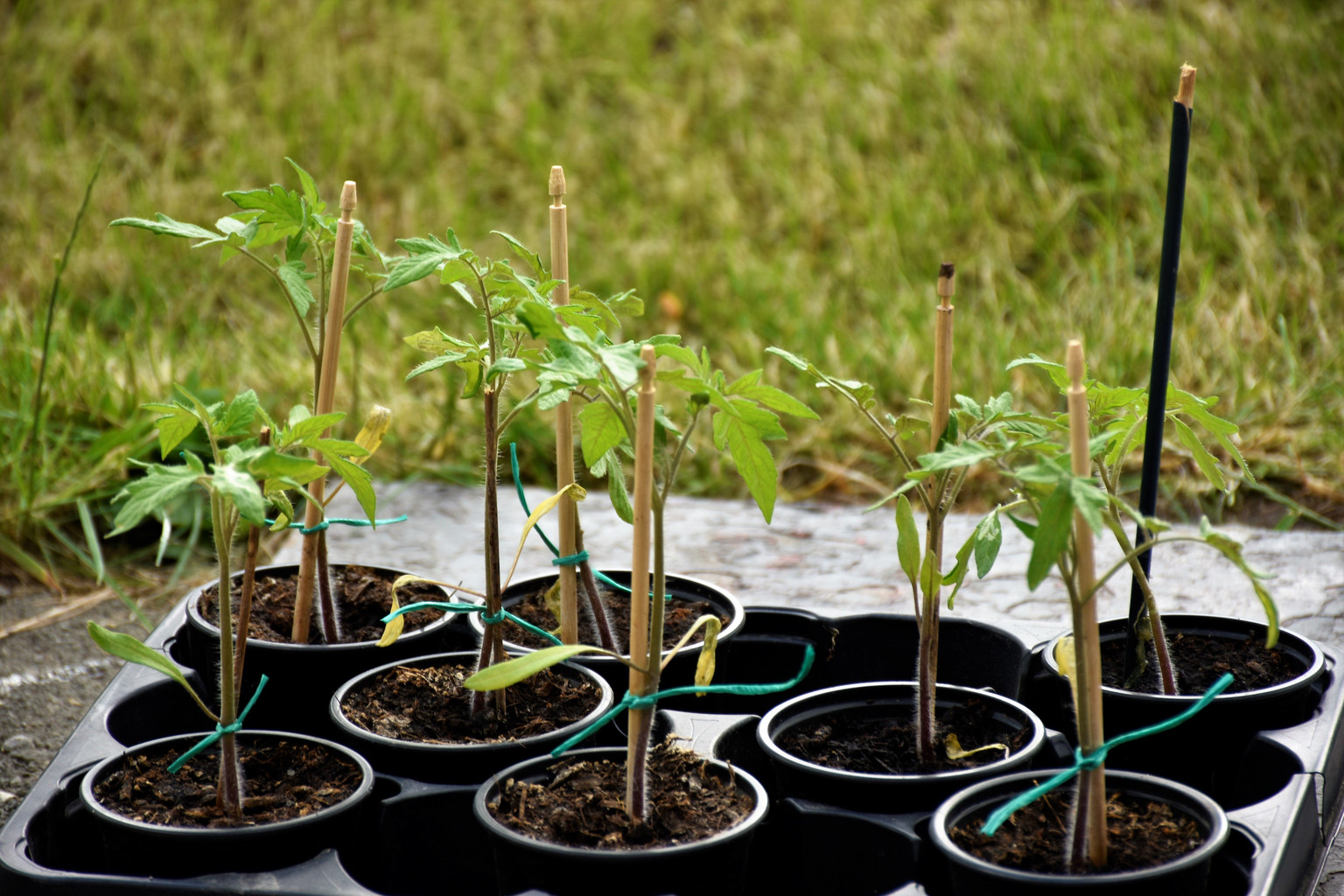

Before buying plant food for your vegetable pots, it helps to take stock of what is already in them. Fertilizer included in the mix and anything you have applied since planting can affect whether another feeding is appropriate.
Gather the mix and fertilizer labels, the crop’s growth stage, and any feeding records. Then use the matching product directions to plan and record any needed application. If essential information is missing, resolve it before choosing or calculating another rate.
Start With What Your Container Already Has
Gather the crop and growth stage, potting-mix label, any compost or amendments, fertilizer label, and notes about previous applications. Record what is known; do not assign guessed nutrient amounts to compost or assume a mix is depleted after a set number of weeks.
If the growing medium, its included fertilizer, or previous feedings are unknown, obtain the actual mix and fertilizer labels and past-application information first. Resolve those gaps before planning or calculating another application.
Check whether the mix already includes fertilizer and what its label says about use and intended supply. A precharged mix, amendment, or recent feeding can change whether another application is appropriate. Before adding anything, check the potting mix and fertilizer already supplied.
Read Analysis And Application Directions Separately
A guaranteed analysis reports nutrient percentages by weight. Application directions tell you where, when, and how much product to use. Those are separate parts of the label.
For example, the checked Garden-tone 3-4-4 analysis lists 3.0% total nitrogen (N), 4.0% available phosphate (P₂O₅), and 4.0% soluble potash (K₂O). Those percentages describe the product’s guaranteed analysis. P₂O₅ and K₂O are oxide reporting bases, not elemental phosphorus and potassium percentages; none of the figures is a dose.
For a plain-language explanation of label analysis, see how to read fertilizer nutrient percentages.
Next, find the directions for the exact product and use. Note the crop or container type, whether the instructions are for new or established plants, the amount, and the basis for that amount. A rate may be per pot diameter, per volume of mix, or per volume of water. These units are not interchangeable.
A soluble product’s mixing rate tells how much product to add to a volume of water. It does not automatically tell how much prepared solution to apply to one pot. Record both the mixture and the label’s application instructions. Do not turn a concentration into a per-pot amount without a product direction.
Compare Form And Release Behavior
Form and release are related, but they are not the same thing.
| What The Label Calls It | What That Tells You | What To Check |
|---|---|---|
| Water-soluble | The product dissolves for use in water. | Copy the product-to-water rate and the directions for applying the prepared solution. |
| Granular | The product is in dry particles. | Granules alone do not show how quickly nutrients become available or how long they last. |
| Slow- or Controlled-Release | The formulation is described as releasing nutrients over time. | Use the product’s release directions and conditions; moisture and temperature affect some coated products. |
The Garden-tone 3-4-4 label lists some nitrogen as slow release. That does not establish that the granules are resin-coated or set a release period for the whole product. Organic ingredients do not automatically mean slow release. Do not add a second fertilizer just because one product is granular or described as slow release.
Turn The Directions Into A Plan
Use one plan entry for each product and application. Keep the same crop, medium, product, units, and dates together.
- Confirm the starting conditions. Note the crop and stage, growing mix and included fertilizer, amendments, pot details, and previous applications. Obtain missing label or feeding-history information before calculating another application.
- Match the use directions. Confirm the exact product and formulation, intended container use, and label branch for the plant’s stage.
- Copy the rate and basis. Keep product units attached to their basis, such as teaspoons per 4 inches of pot diameter or product per volume of water. Calculate only from that printed basis.
- Record the application. Include the measured amount or dilution, method, date, watering instructions, and handling precautions.
- Record the repeat direction and review point. Copy the label’s repeat timing and relevant conditions. Recheck the plant, inputs, and current directions before another application; a review date is not an automatic feeding date.
A Hypothetical Label-To-Plan Example
This is a hypothetical example, not a plant trial or product recommendation. It uses the current manufacturer fact sheet for established potted plants. The sheet may not match every retail bag, so check the actual product and formulation before using the example.
| Plan Entry | Hypothetical Record |
|---|---|
| Crop and stage | One established, actively growing pepper; not a seedling or herb. |
| Pot and growing conditions | Freely draining round pot; actual diameter 12 inches, stem centered, with room at the outer edge. Growing mix and feeding history are known; no fertilizer precharge or recent application calls for deferring another feed. It is a July growing-season scenario with normal moisture and drainage; the plant is not drought-stressed. |
| Product and use branch | Garden-tone 3-4-4, only if the current bag matches; Potted Plants → Established Plants. |
| Label rate | 1.5 teaspoons of product for every 4 inches of pot diameter. |
| Calculation | 12 inches ÷ 4 inches = 3; 1.5 teaspoons × 3 = 4.5 teaspoons of product for one application. |
| Method | Measure 4.5 teaspoons accurately. Sprinkle along the soil’s outer edge, keep it 3 inches from the stem and off stems and foliage, then water thoroughly. |
| Handling and storage | Wear gloves and wash hands after use. Store in a cool, dry place out of reach of children and pets; follow the current package directions. |
| Record and next review | Record the hypothetical July application and set August as the next monthly review. Before a repeat, recheck the plant, mix, prior inputs, and actual bag directions. |
The manufacturer directs monthly feeding during the growing season, usually May through August. That is this product’s feeding direction, not a release-life claim or a schedule for every fertilizer. In the July example, the August review is when the gardener checks the plant, inputs, and current bag before deciding whether to repeat under those directions.
This example uses the established-pot branch only. The manufacturer’s new-mix directions conflict internally, and the checked product page and fact sheet give different transplant-start timing. Neither branch is used here. For a new mix or transplant, obtain manufacturer clarification for the applicable directions before applying a rate. When the actual bag, medium, or feeding history does not match the example, do not use the 4.5-teaspoon amount; obtain matching product information first.
When To Pause And Review A Problem
When overfeeding or salt buildup is a concern, pause additional feeding and check the product, measured amounts, dates, other inputs, growing mix, water, and drainage. Too much fertilizer can injure roots; compost and irrigation water can also contribute salts. A crust, yellowing, or wilt alone does not identify a nutrient problem or prove overfeeding.
Growing-medium electrical conductivity (EC) depends on the medium and the extraction method. A tap-water result is a different sample and does not replace a growing-medium test. For the separate source-water question, understand what your tap water contributes.
When a problem persists, use advice or testing suited to the crop and growing medium. Give the adviser or lab the fertilizer and watering history, and follow its sample-collection directions. Do not apply a universal EC cutoff, flushing calendar, or corrective chemical treatment based on one symptom.