
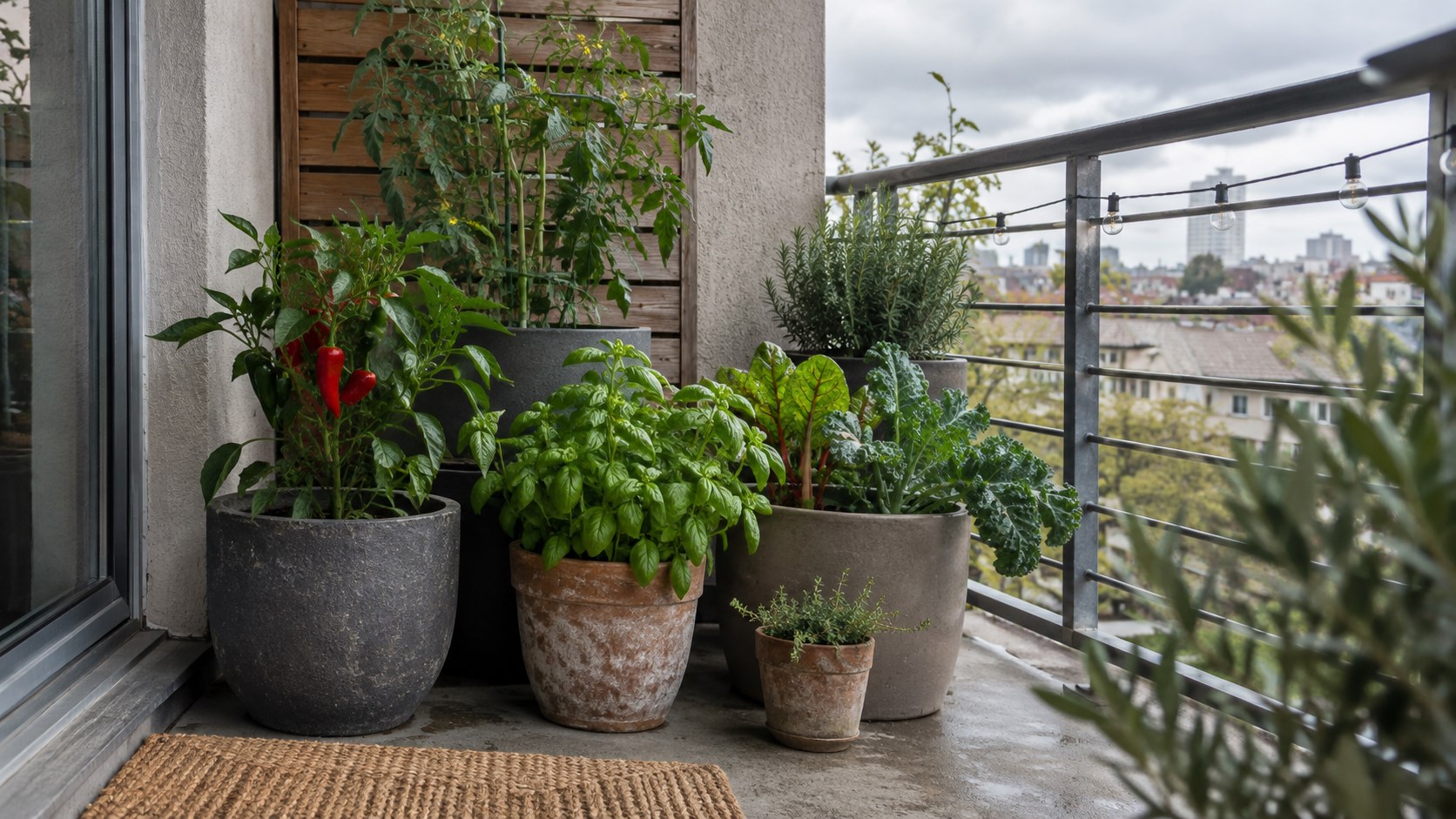

Finding room for vegetables on a windy balcony involves more than choosing the sunniest corner. You also need to consider where ordinary breezes reach the plants, which spots offer shelter, and whether the arrangement respects access and building rules.
Start with observations from indoors or another protected position, then compare possible container locations. A heavy pot or wind screen alone does not make a setup safe. Use the checks below for everyday planning, never as a reason to test an exposed balcony during strong wind.
Identify The Exposed Parts Of Your Balcony
Sketch the balcony from above. Mark the doorway, fixed walls, open edges, and possible floor locations for containers. From indoors or another protected position, note where ordinary breezes reach the balcony. Existing nearby foliage can offer a visual clue, but do not go near an exposed edge to take a reading or use a storm or high-wind event as a test.
Add the date, time, and general weather to your notes. Label each spot as exposed, more sheltered, or unknown. The map records patterns; it does not measure wind or assess balcony safety. Keep severe-weather forecasts separate from everyday observations.
| Candidate Spot | Example Observation | Planning Note |
|---|---|---|
| Open edge | Leaves move during ordinary breezes | Mark as exposed; keep containers on the permitted floor area |
| Beside a wall | Less movement than at the open edge | Compare the shelter with crop light and access needs |
| Corner | Movement varies or is unclear | Mark as unknown until it can be observed safely |
These entries are examples, not measurements from a real balcony. A wall can provide some shelter from strong winds, though it can also reduce air circulation around plants. Container location guidance covers both effects.
Choose Positions That Do Not Create Falling Hazards
Keep pots on the floor within the permitted area; never set them on a railing or hang them over an edge.
Plan for the complete planted setup—the container, growing mix, mature plant, and any support or watering equipment—because an empty pot does not represent its finished weight. Do not use a guessed weight, heavier pot, or improvised tie as proof of safety; general gardening advice cannot establish balcony load limits or approved tie points.
Shelter is only useful when the spot still works for the crop. A wall may reduce wind but also change the light and airflow. Compare the candidate position with the crop’s needs and the direct-sun observations in How To Measure Sunlight Before Placing Your Containers. Keep access to water and a clear route through the balcony in the plan as well.
Use this checklist for each possible position:
- Confirm the building allows containers in this spot.
- Keep the pot on a level floor surface within the permitted area.
- Check that the spot gets the crop’s needed light.
- Keep the doorway and route to water clear.
Evaluate Wind Protection Without Enclosing The Garden
A screen may reduce direct exposure, but it adds another object that needs an approved location and attachment. In landscape windbreaks, an open-weave barrier can shelter a broader area downwind than a solid fence, as described in landscape windbreak guidance. That comparison does not predict how a screen will perform on a particular balcony or how it should be mounted.
| Check | Evidence To Confirm | Skip The Screen When |
|---|---|---|
| Building rules | The exact screen and its location are permitted | The rules do not allow it or approval is missing |
| Product instructions | The maker’s instructions cover the intended outdoor use and mounting surface | Instructions do not cover the proposed installation |
| Light and access | The screen will not block needed crop light, the doorway, or routine access | It creates shade or an obstruction the garden cannot accommodate |
| Exposure information | Any stated wind or exposure rating applies to the product and setup | No relevant rating or mounting information is available |
Plan Supports And Secure Loose Equipment
List what could shift or blow around before planting: empty pots, seed trays, hand tools, plant labels, watering equipment, loose covers, and supports. Decide where small, manageable items can be stored indoors before strong winds arrive. Keep storage out of the doorway and other shared routes.
Choose plant supports with the mature crop in mind, and follow the support maker’s directions for assembly and use. Check building rules before attaching a trellis, tie, or screen to a wall or railing. Do not improvise an anchor or assume that a plant support can also hold a wind screen.
Prepare for high winds before they arrive. When a high-wind watch is issued, secure loose outdoor items while conditions are still safe. Move only items you can handle safely. During a high-wind warning, stay indoors rather than going back out to retrieve a pot or tool.
Recheck After Wind And Adjust The Arrangement
Once conditions allow safe access, compare the balcony with your map. Note whether a container shifted, a support loosened, a route became blocked, or leaves were damaged. Check the potting mix before watering: wind can dry container media faster than a sheltered location, so use the moisture-check approach in How To Water Container Vegetables Without A Fixed Schedule.
Record the spot, what changed, what you adjusted, and what needs another check. Hypothetical example: An exposed corner catches regular breezes, while a floor spot beside a wall is calmer. If the wall-side spot is allowed, gets the crop’s needed light, and leaves access clear, it is the stronger candidate. Skip a screen that requires an unapproved railing attachment.