
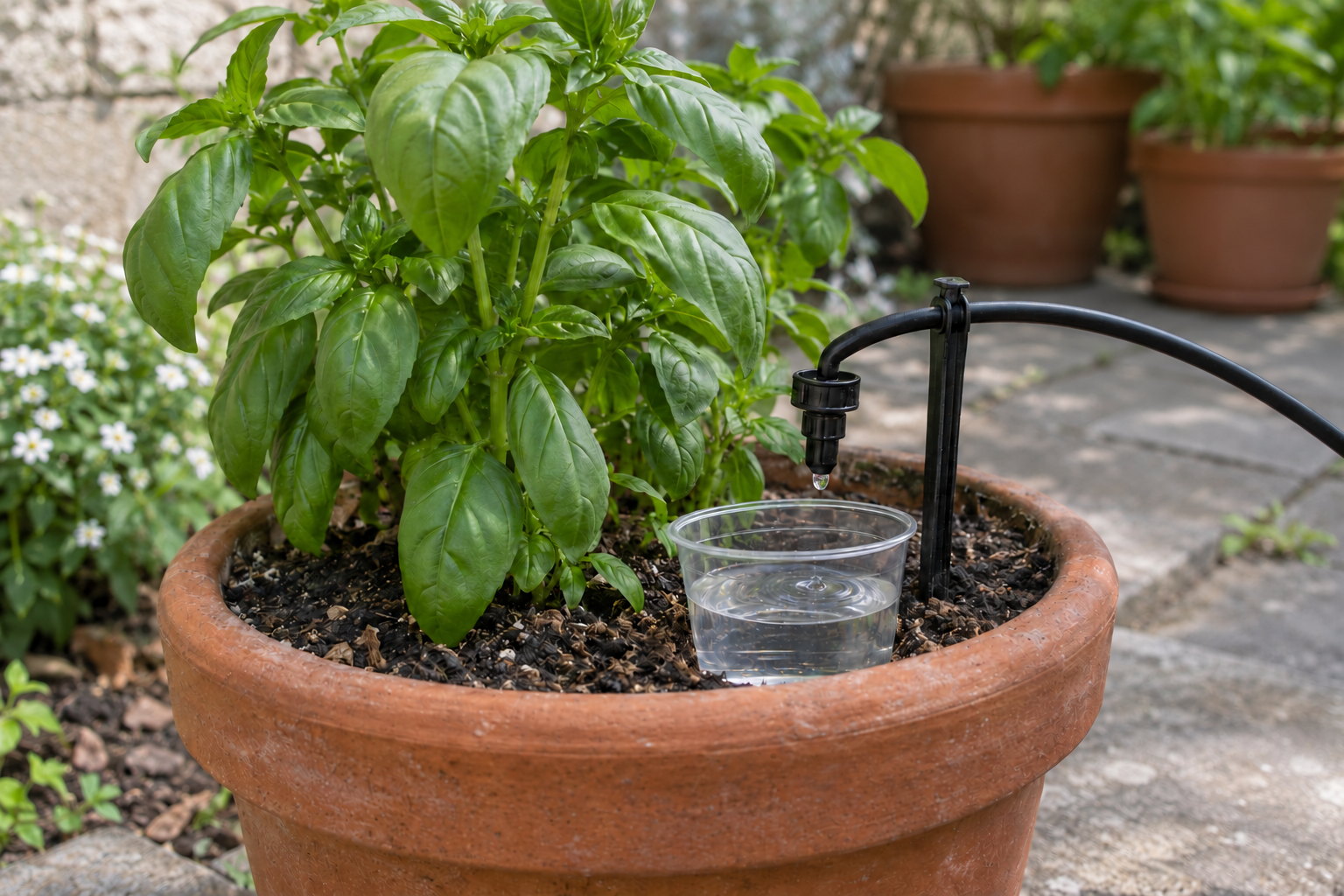

You can see water leaving each outlet of a drip system and still need to check how much each one delivers. That comparison is useful when you want to understand why pots may be receiving different amounts.
A timed collection lets you compare suitable matching outlets, called emitters, under normal operating conditions. Keep different rated outputs in separate groups, and repeat surprising readings before changing the system. The steps below explain what to compare and how to record it.
Check What You’re Comparing
Start with the emitters already installed. Record the exact model and rated flow where you can identify them. Group fixed-flow emitters with the same model and rated output. For adjustable emitters, compare the same model at the same setting, leaving each setting unchanged during the check. Matching dial positions on different models do not establish equal output.
Mark an unknown model, rating, or setting as unknown. You can still record its output, but you cannot assume it should match another outlet. Emitters designed for different flow rates should be kept in separate groups.
Note how many outlets serve each pot. This check measures one outlet at a time. Over the same run, two outlets each delivering the same rate will send twice as much water to a pot as one of those outlets alone.
Map The Outlets And Keep Normal Conditions
Label each accessible outlet A, B, C, and so on. On a simple sketch, mark the pot it serves, its position relative to the water supply, and whether it sits higher or lower than the other outlets. Mark anything you cannot measure.
Leave outlets at their usual height and position. Keep the tubing, valves, active zone, and adjustable settings as they normally run, with the usual outlets operating. Place a supported collector under each outlet without blocking the stream or pulling the outlet down. If you cannot collect the water without changing the setup, mark that outlet unmeasured.
Write down any operating pressure you know, or mark it unknown. For a gravity-fed setup, record the reservoir level and any change during collection; elevation and friction in the line can change pressure.
Run the zone normally and wait for the flow to settle. This checks steady output during collection. It does not measure total delivery over a very short run that includes startup and water draining after shutoff. If the flow never settles, record that limitation and consult the system instructions before treating the readings as steady output.
Collect Each Outlet For The Same Time
Use labeled collection containers, a timer, and a graduated measuring cup or cylinder. Choose collectors large enough to hold the full sample, and use measuring marks you can read. Catch the full stream without moving or obstructing the outlet.
Measure emitter output over a fixed time, choosing an interval that produces a readable volume without overflowing. Use that same actual elapsed time for every outlet.
If you cannot start all catches together, stagger them while keeping the system conditions stable. For example, collect from A from 0:00 to 5:00 and from B from 0:10 to 5:10. Both samples last five minutes. Five minutes is an example, not a prescribed collection duration.
Record a valid zero if the collector stayed correctly positioned for the full interval and caught no water. Repeat a sample if water missed the container, spilled, overflowed, or the timing was off. Keep the invalid-catch note so it is clear why you repeated it.
Convert Each Catch To A Flow Rate
Convert the measured volume into U.S. gallons per hour (gph) to compare outlet rates with applicable model ratings:
Flow (U.S. gph) = collected mL × 60 ÷ (actual minutes × 3,785.412)
The calculation uses NIST’s rounded conversion of 3.785412 liters per U.S. gallon. For example, a 315 mL catch over five minutes is 315 × 60 ÷ (5 × 3,785.412), or about 1.00 U.S. gph. An hourly rate is a unit conversion, not a watering duration.
Hypothetical Example Only: These invented catches assume four identical emitters rated at 1.0 gph under comparable, stable conditions. They are not product test results or watering advice.
| Outlet | Actual Minutes | Collected mL | Flow (U.S. gph) | Record |
|---|---|---|---|---|
| A | 5 | 315 | 1.00 | Retain reading |
| B | 5 | 310 | 0.98 | Retain reading |
| C | 5 | 320 | 1.01 | Retain reading |
| D | 5 | 160 | 0.51 | Repeat catch; cause unknown |
Compare Like Outlets And Recheck Surprises
Compare outlets within each group, using equal collection times and the conditions you recorded. Similar readings can all be below the rated output. Compare the measured rates with the exact emitter model’s rating only in light of its stated operating conditions. If pressure is unknown, mark that rating comparison as uncertain.
A low reading alone cannot distinguish pressure variation, a blocked outlet, or a collection error. Repeat it in the same setup, then check the model instructions before changing anything.
This small-garden worksheet provides a practical comparison of the outlets you measured. It does not apply a formal uniformity test or assign a universal pass percentage.
Matching outlet rates do not establish whether each plant receives the water it needs. Check whether the container mix needs water separately.
Keep A Useful Baseline
Save the first readings with the date and system conditions as a reference for later checks. A baseline records what you measured; it does not certify correct output. If you change something later, record what changed and repeat the check under comparable conditions.
Use one record per outlet and collection attempt. Keep the same outlet IDs on the sketch and in the log, including when you repeat an invalid or surprising catch.
| Field | Record |
|---|---|
| Date | __________ |
| Outlet ID And Location | __________ |
| Pot Served | __________ |
| Exact Model | __________ |
| Rated Flow / Unchanged Adjustable Setting | __________ |
| Operating Pressure Or Unknown / Supply Conditions | __________ |
| Actual Collection Time In Minutes | __________ |
| Collected Volume In mL | __________ |
| Calculated Flow In U.S. gph | __________ |
| Valid Catch, Valid Zero, Or Invalid Catch And Reason | __________ |
| Action / Change Made | __________ |
| Retest Reference And Result | __________ |