
Putting a vegetable pot on a deck or balcony also means deciding where its drainage water will go. A saucer, mat, or raised support may look suitable, but the surface beneath it and the route beyond the pot still need checking.
Start with the surface’s care instructions and a permitted destination for runoff. Keep drainage open, and choose collection equipment you can reach to empty and inspect. The arrangements below help you think through those jobs before committing to one.
Check The Surface Before Choosing A Protector
Identify the surface material, product line, and any coating or membrane beneath the pot. Find the owner’s or manufacturer’s care guide and record its date or version, allowed contact materials, cleaning restrictions, and runoff rules. “Composite deck” or “tile” may not identify the finish well enough to choose a mat or cleaner.
Containers may scratch or mark surfaces, and drained water may stain concrete or wood decking. These surface and drainage considerations for container growers make the actual finish part of the decision.
For example, the Trex Signature care and cleaning guide warns that rubber-backed mats may sometimes discolor or lighten that decking. This is guidance for the named product line; confirm the suitability of any proposed mat or pot foot for your own surface.
If the finish or membrane is unknown, ask the responsible owner or manufacturer before choosing a contact material or cleaner. A pad, saucer, or riser still needs that compatibility check.
Trace The Whole Runoff Route
Write the route in one line:
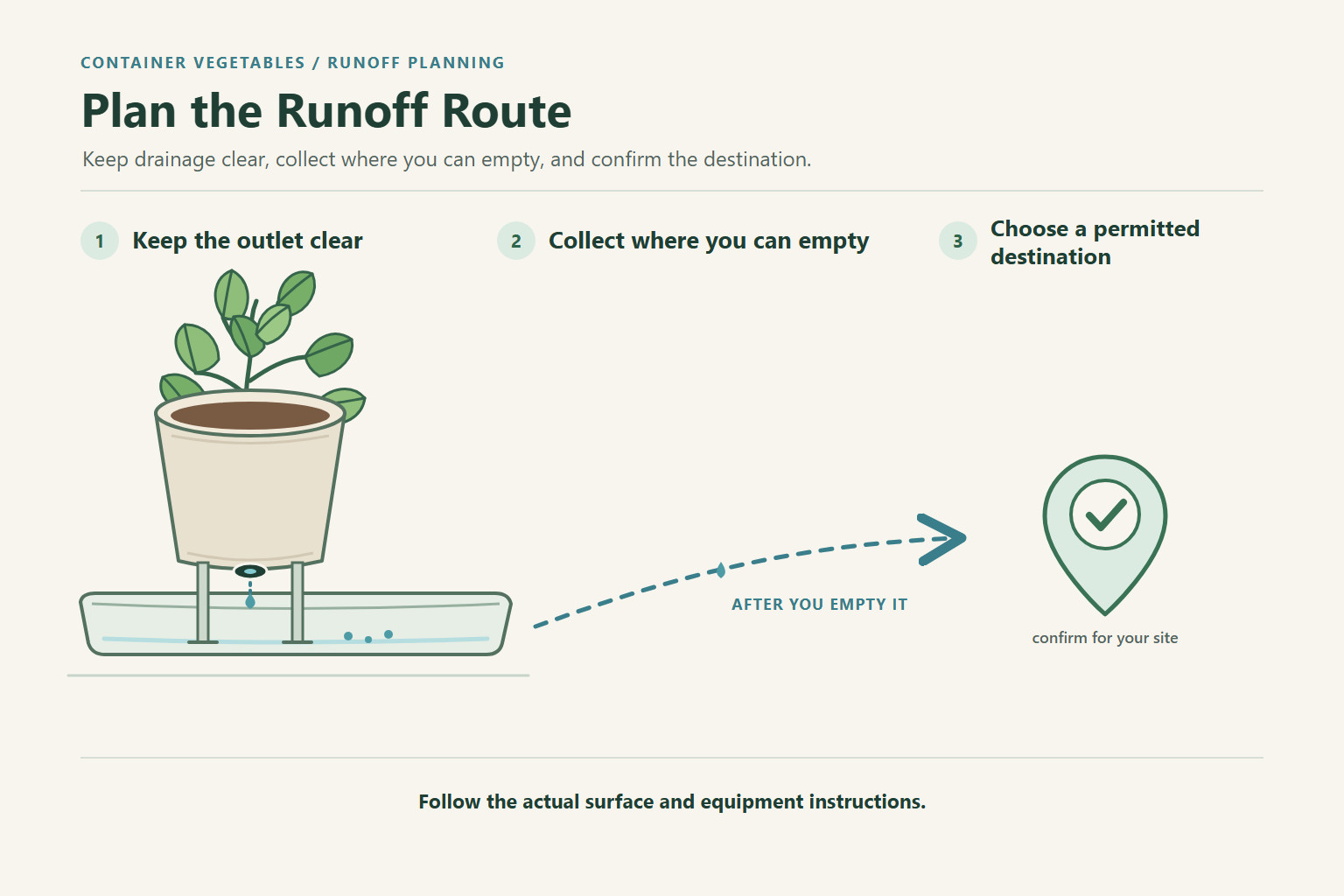
Pot outlet → collection or support → possible overflow → permitted destination → access to empty and inspect
Follow water beyond the pot, including what happens during rain or when a collector fills. Note the surface underneath, nearby doors and walking areas, and any neighbor or lower level affected. Confirm the receiving point with the property rules; do not assume a railing opening, balcony edge, or nearby drain is an allowed destination.
An ordinary pot needs an open drainage hole so excess water can leave and air remains available around the roots. A removable saucer catches that water for emptying. Guidance on drainage and removable saucers explains these roles. Keep the outlet open, and do not add gravel inside the planted pot as a drainage fix. Potting Mix And Drainage For Container Vegetables covers the pot-side setup.
A decorative outer pot can collect water from a removable planted pot, but the inner pot must not stand in the pooled water. If you cannot empty the outer pot without lifting a heavy planted container, change the collection arrangement before using it.
A self-watering container uses a designed reservoir to supply the mix and may still have an overflow. Self Watering vs Standard Containers for Vegetables explains the design distinction. As one example, Step 12 of EarthBox’s 2022 instruction manual identifies water leaving the overflow drain when the reservoir is full. That describes the system in that manual; follow the instructions for your actual model and include its overflow in the route.
Compare Three Runoff Arrangements
Apply the same checks to each option: an open outlet, compatible surface contact, a permitted water destination, and reachable emptying and inspection.
| Arrangement | Water Handling | Check Before Use |
|---|---|---|
| Removable saucer or outer collector | Catches water and debris; needs emptying. | Keep the inner pot out of pooled water. Confirm reachable emptying and where overflow will go, including during rain. |
| Raised support or caddy | May provide outlet clearance and inspection access; does not collect runoff. | Check instructions for the loaded setup, stability, surface contact, and a receiver for the water. |
| Allowed open drainage | Sends water to a receiving surface or drain. | Confirm that both the surface instructions and property rules permit the complete route, including overflow and downstream effects. |
The underside also deserves a check. In one gardener’s deck-protection account, the gardener describes a fabric bag sagging between edge supports and a protruding cage scratching the deck when she dragged the bag. Inspect your container’s actual bottom and any frame ends before choosing a support or planning a move. Her account does not establish how every bag or support will behave.
Check The Route Before Committing To It
Confirm the surface and equipment instructions and the permitted destination first. Have suitable containment ready. Where the site allows a water check, use only a small amount you can control while observing the outlet, under-pot contact, collector, possible overflow, and receiving point.
Stop at the first unwanted runoff, contain it, and revise the arrangement before using it. If even a small amount cannot be contained without risking the surface or another property, skip the water check and resolve the arrangement first.
This step observes where that application of water goes. It does not establish waterproofing, load capacity, storm performance, or whether the roots are evenly watered. Keep watering decisions separate with How To Water Container Vegetables Without A Fixed Schedule.
Keep Emptying And Inspection Within Reach
Empty collected saucer water regularly, including after rain. Recheck the arrangement after setup, overflow, new debris, moving a pot, or noticing a mark. Record the date, what collected or changed, the underside and outlet conditions, your action, any unresolved question for the owner or manufacturer, and the next check trigger.
Use the exact finish’s instructions for cleaning. For Trex Signature, its care guide directs users to check chemical labels and contact Trex about a cleaner’s suitability. The guide separately covers mold on surface biofilm when pollen and dirt remain, and mineral deposits left when hard water dries. Those descriptions do not diagnose every mark. Follow the guide for your actual surface rather than transferring a cleaner or washing method between materials.
Before placing or filling the container, finish the surface record and runoff route. Change any arrangement that leaves emptying, inspection, compatibility, or the receiving point unresolved while the pot is still easy to move.